AI Process Automation Services for Enterprise Productivity: A Complete Guide for 2026
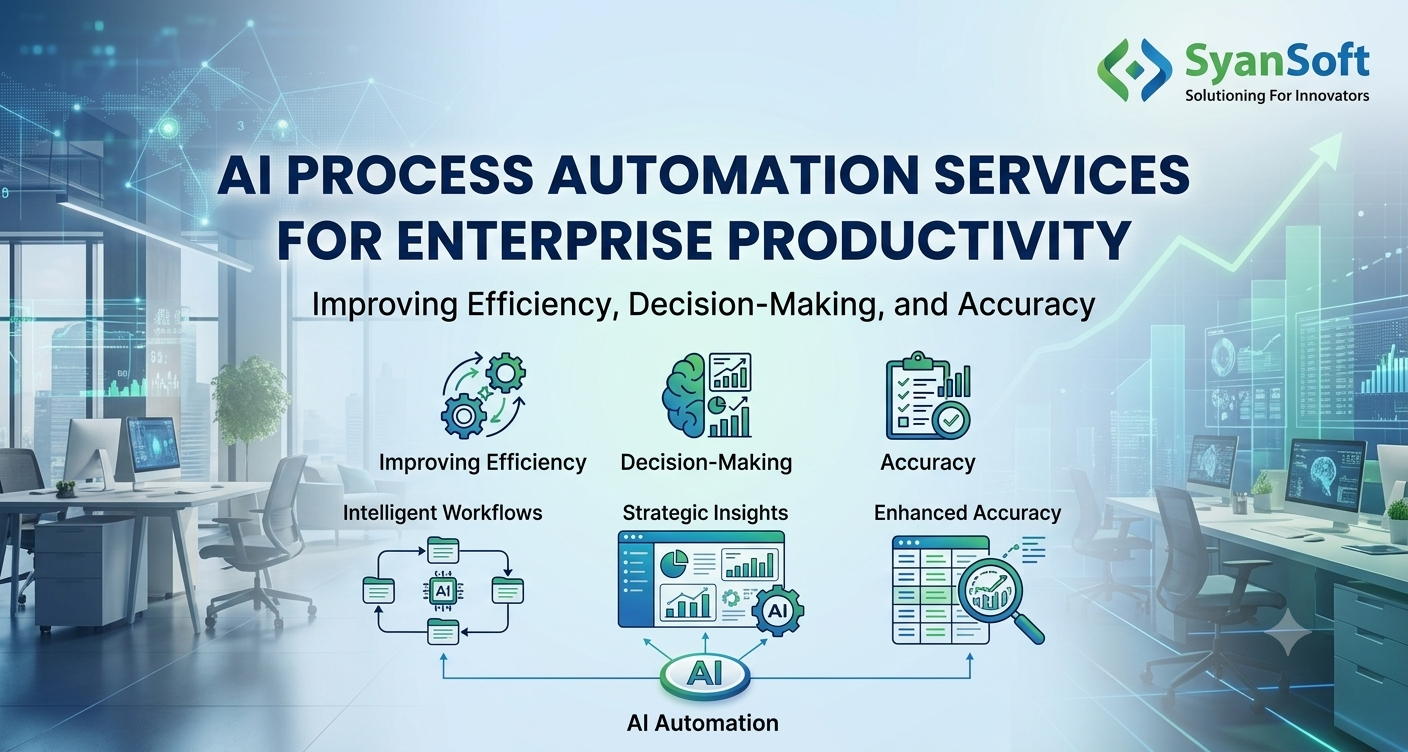
AI process automation helps enterprises improve productivity by automating repetitive tasks, connecting business systems, and streamlining complex workflows. In 2026, businesses are adopting AI-powered automation to reduce manual effort, minimize errors, improve operational efficiency, and enable employees to focus on strategic activities.
As organizations manage increasing workloads and growing customer expectations, traditional manual processes can slow down business operations. AI-driven automation offers a smarter way to manage everyday tasks while improving accuracy, scalability, and overall business performance.
What Are AI Process Automation Services?
AI process automation services use artificial intelligence, machine learning, and workflow automation technologies to manage repetitive and time-consuming business activities with minimal human intervention.
Unlike traditional automation, which follows predefined rules, AI-powered automation can analyze information, recognize patterns, process unstructured data, and support decision-making.
These solutions help enterprises automate processes across departments, including finance, HR, customer support, sales, IT operations, and supply chain management.
How AI Process Automation Improves Enterprise Productivity
AI automation helps businesses optimize daily operations while reducing unnecessary manual work. Here are some important ways it improves enterprise productivity:
1. Automates Repetitive Business Tasks
Employees often spend valuable time on routine activities such as data entry, invoice processing, report generation, and document management. AI automation handles these tasks faster, allowing teams to concentrate on business growth and important responsibilities.
2. Improves Workflow Efficiency
AI-powered workflows connect different business processes and applications. From approval management to customer onboarding, automation helps reduce delays, eliminate unnecessary steps, and maintain consistent operations.
3. Reduces Operational Costs
Manual processes require additional time, resources, and administrative effort. Automating repetitive activities helps enterprises optimize resource utilization, reduce operational expenses, and improve overall efficiency.
4. Enhances Data Accuracy
Human errors during data entry and document processing can affect business decisions. AI-powered systems can extract, validate, categorize, and process information more consistently, helping organizations maintain accurate business records.
5. Supports Faster Decision-Making
AI systems can analyze large volumes of business data and identify useful patterns. These insights help management teams make informed decisions, identify operational challenges, and respond to changing business requirements.
6. Enables Business Scalability
As businesses expand, managing increasing workloads through manual processes becomes difficult. AI automation allows enterprises to handle growing operational demands without proportionally increasing their workforce or administrative workload.
Key Enterprise Processes That Can Be Automated with AI
Organizations can implement AI automation across multiple business functions.
AI Process Automation vs. Traditional Automation
Traditional automation and AI-powered automation both improve operational efficiency, but they work differently.
|
Traditional Automation |
AI Process Automation |
|---|---|
|
Follows predefined rules |
Learns from patterns and data |
|
Handles structured tasks |
Can process structured and unstructured data |
|
Requires rule-based configuration |
Can adapt using AI models |
|
Limited decision-making capabilities |
Supports intelligent decision-making |
|
Best for repetitive workflows |
Suitable for complex business processes |
Combining both approaches allows enterprises to build more flexible and intelligent automation systems.
How to Implement AI Process Automation in Your Enterprise
Successful AI implementation requires a structured approach. Businesses should consider the following steps:
Why Choose SyanSoft for AI Process Automation Solutions?
Implementing AI automation requires the right technology, integration strategy, and understanding of business operations. SyanSoft Technologies helps organizations explore intelligent AI solutions that support digital transformation and operational efficiency.
With a focus on customized technology solutions, businesses can leverage AI to streamline workflows, automate repetitive activities, improve data management, and enhance decision-making.
Explore AI Process Automation Services by SyanSoft to discover AI-driven solutions that can help your enterprise build smarter and more efficient business operations.
Conclusion
AI process automation is becoming an important part of enterprise productivity in 2026. By automating repetitive tasks, improving workflow management, reducing operational costs, and supporting data-driven decisions, businesses can create more efficient and scalable operations.
Enterprises that adopt intelligent automation can improve employee productivity, respond faster to business challenges, and build a stronger foundation for long-term digital transformation.
Frequently Asked Questions (FAQs)
1. What are AI process automation services?
AI process automation services use artificial intelligence, machine learning, and automation technologies to streamline business workflows, reduce manual tasks, and improve operational efficiency.
2. How does AI process automation improve enterprise productivity?
It improves productivity by automating repetitive activities, reducing human errors, accelerating workflows, and allowing employees to focus on higher-value business tasks.
3. Which business processes can be automated using AI?
AI can automate finance, HR, customer support, sales, marketing, IT operations, document processing, and supply chain management activities.
4. Is AI process automation suitable for small and large enterprises?
Yes. AI process automation can be customized for businesses of different sizes depending on their operational requirements, budgets, and automation goals.
5. How can enterprises start implementing AI process automation?
Enterprises can begin by identifying repetitive workflows, defining automation goals, selecting suitable AI technologies, integrating existing systems, and monitoring performance.


Comments
Post a Comment