Intelligent Document Processing | SyanSoft Technologies
Businesses handle thousands of invoices, contracts, forms, applications, reports, and other documents every day. Manually extracting and organizing this information can be slow, expensive, and prone to errors. Intelligent Document Processing (IDP) uses AI, machine learning, optical character recognition (OCR), and natural language processing (NLP) to automatically capture, understand, classify, and process information from documents.
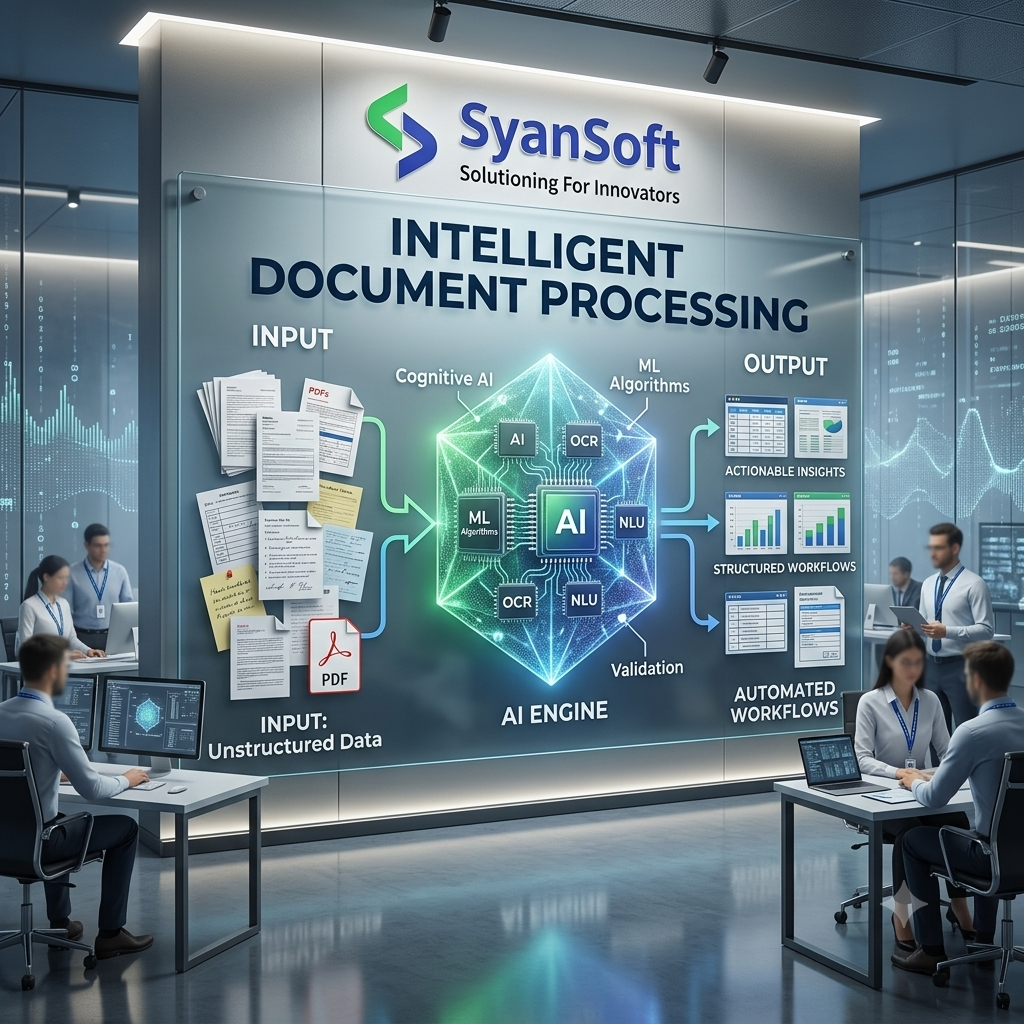
For businesses looking to modernize document-heavy workflows, Intelligent Document Processing can help reduce manual work, improve data accuracy, and accelerate business operations.
What Is Intelligent Document Processing?
Intelligent Document Processing is an AI-powered technology that converts information from structured, semi-structured, and unstructured documents into usable digital data. Unlike traditional OCR, which primarily reads text from documents, IDP can understand document context, identify important fields, classify documents, validate information, and trigger automated workflows.
For example, an IDP solution can process an invoice, identify the vendor name, invoice number, tax amount, total amount, and due date, and then send the extracted information directly to an ERP or accounting system.
How Does Intelligent Document Processing Work?
An intelligent document processing workflow generally includes several stages:
1. Document Capture
Documents are collected from emails, scanners, cloud storage, portals, mobile applications, or enterprise systems.
2. Document Classification
AI models identify the type of document, such as an invoice, purchase order, contract, tax form, claim, or application.
3. Data Extraction
OCR, AI, and machine learning models extract relevant information from text, tables, images, and other document elements.
4. Data Validation
Extracted information can be checked against predefined business rules, databases, or other enterprise systems to identify missing or inconsistent data.
5. Human Review
Documents or fields requiring additional verification can be routed to employees for review, helping businesses maintain control over critical processes.
6. Workflow Automation
Validated information is transferred to connected systems such as ERP, CRM, accounting, document management, or workflow platforms.
Key Benefits of Intelligent Document Processing
Implementing IDP can provide several business advantages:
-
Reduce manual data entry: Automate repetitive document-processing tasks.
-
Improve data accuracy: AI-based extraction can reduce errors associated with manual entry.
-
Process documents faster: Handle large document volumes more efficiently.
-
Lower operational costs: Reduce the amount of time employees spend on repetitive tasks.
-
Improve compliance: Create more consistent and traceable document workflows.
-
Scale business operations: Process increasing document volumes without proportionally increasing manual effort.
-
Improve employee productivity: Allow teams to focus on analysis, customer service, and higher-value activities.
Intelligent Document Processing Use Cases
IDP can be applied across many industries and business functions.
Finance and Accounting
Organizations can automate invoice processing, receipt extraction, expense documents, purchase orders, and financial records.
Insurance
Insurance companies can process claim forms, policy documents, medical records, and supporting documentation more efficiently.
Healthcare
Healthcare organizations can extract information from patient forms, medical documents, insurance records, and administrative paperwork.
Tax and Compliance
Businesses can automate the extraction and validation of tax-related information from financial and compliance documents.
Banking and Financial Services
Banks can use IDP for loan applications, KYC documentation, account forms, statements, and other customer records.
Human Resources
HR teams can process resumes, employee forms, onboarding documents, applications, and employment records.
IDP vs. Traditional OCR
Traditional OCR mainly focuses on converting printed or scanned text into machine-readable text. Intelligent Document Processing goes further by combining OCR with AI and other technologies to understand document content and automate downstream processes.
OCR asks: “What text is present?”
IDP asks: “What does this information mean, and what should happen next?”
This makes IDP more suitable for complex business workflows where documents contain different layouts, tables, fields, and contextual information.
Why Businesses Need AI-Powered Document Processing
As organizations become increasingly digital, document volumes continue to grow. Simply digitizing documents is not enough if employees still have to manually read, interpret, and enter information.
AI-powered document processing creates an intelligent layer between documents and business applications. It can help organizations transform unstructured information into actionable business data while connecting document processing with automated workflows.
Intelligent Document Processing with SyanSoft Technologies
SyanSoft Technologies helps businesses explore AI-driven solutions designed around their specific operational requirements. Our approach can combine AI, OCR, machine learning, NLP, automation, and enterprise integrations to create document-processing workflows that fit existing business processes.
Whether you need automated invoice extraction, document classification, data extraction, workflow automation, or integration with enterprise applications, an AI-powered approach can help improve efficiency and scalability.
Conclusion
Intelligent Document Processing enables businesses to move beyond basic document scanning and manual data entry. By combining AI, OCR, NLP, machine learning, and workflow automation, organizations can extract meaningful information from documents and connect it directly to business processes.
For companies handling high volumes of documents, IDP can be an important step toward intelligent automation, faster operations, improved accuracy, and digital transformation.
Frequently Asked Questions
1. What is Intelligent Document Processing?
Intelligent Document Processing is an AI-based technology that captures, classifies, extracts, validates, and processes information from digital and physical documents.
2. How is IDP different from OCR?
OCR primarily converts images of text into machine-readable text, while IDP uses AI to understand document structure, context, fields, and business meaning.
3. What documents can IDP process?
IDP can process invoices, contracts, forms, receipts, applications, purchase orders, tax documents, claims, reports, and many other document types.
4. Can Intelligent Document Processing reduce manual data entry?
Yes. IDP can automatically extract relevant information and transfer it into connected business systems, reducing repetitive manual entry.
5. Can IDP integrate with ERP systems?
Yes. IDP solutions can be integrated with ERP, CRM, accounting, workflow, and document-management platforms depending on business requirements.
6. Is Intelligent Document Processing useful for enterprises?
Yes. Enterprises can use IDP to process large document volumes, automate repetitive workflows, and improve operational efficiency.
7. Can IDP process unstructured documents?
Yes. Modern AI-based IDP systems can work with structured, semi-structured, and unstructured documents.
8. What technologies are used in IDP?
Common technologies include OCR, machine learning, natural language processing, computer vision, generative AI, and workflow automation.
9. What are common IDP use cases?
Common use cases include invoice processing, claims processing, KYC, contract analysis, tax document processing, employee onboarding, and application processing.
10. How can SyanSoft help with Intelligent Document Processing?
SyanSoft Technologies can help businesses design and implement AI-powered document-processing solutions aligned with their workflows, data requirements, and enterprise systems.

.jpg)

Comments
Post a Comment