Custom AI Chatbot Development | SyanSoft Technologies
Businesses today are using AI chatbots to improve customer support, automate repetitive tasks, and deliver faster, more personalized experiences. Custom AI chatbot development goes beyond basic rule-based bots by creating intelligent conversational solutions tailored to a company’s workflows, data, systems, and business goals. SyanSoft Technologies helps businesses build scalable AI chatbots designed for real-world enterprise requirements
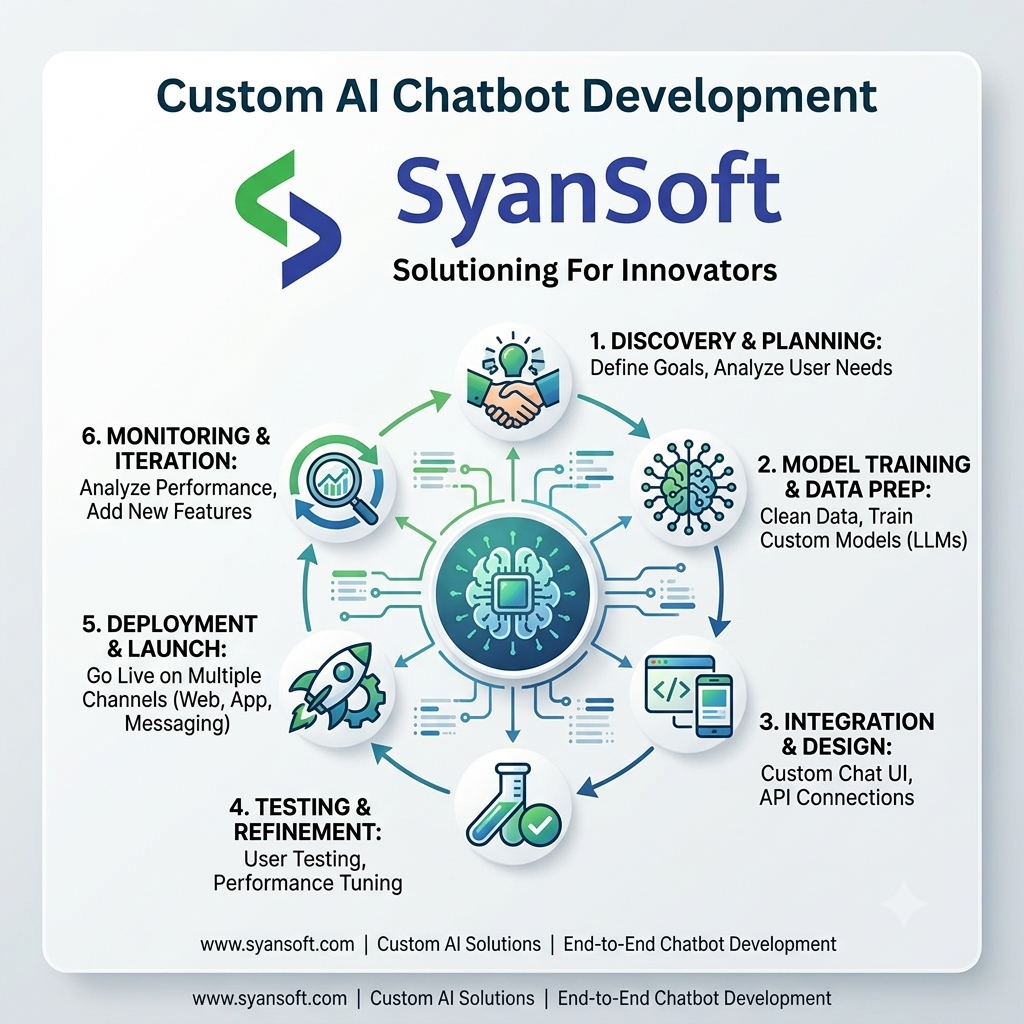
.
What Is Custom AI Chatbot Development?
Custom AI chatbot development is the process of designing and developing an AI-powered conversational system specifically for a business. Unlike generic chatbot platforms, a custom chatbot can be trained or connected to relevant business data, APIs, CRMs, knowledge bases, and internal applications.
Depending on the use case, businesses can build chatbots for customer service, sales qualification, employee assistance, technical support, lead generation, document search, and enterprise knowledge management.
Why Businesses Need Custom AI Chatbots
Traditional customer support often requires employees to answer the same questions repeatedly. AI chatbots can handle these conversations automatically while allowing human teams to focus on more complex tasks.
Key benefits include:
- 24/7 customer assistance: Respond to customer questions at any time.
- Faster response times: Provide instant answers to common queries.
- Lead qualification: Identify visitor requirements and collect relevant information.
- Business automation: Automate repetitive communication and support workflows.
- Personalized conversations: Deliver responses based on customer intent and available data.
- Better scalability: Handle multiple conversations simultaneously.
- Integration capabilities: Connect chatbots with CRM, ERP, databases, APIs, and other business systems.
How Custom AI Chatbot Development Works
A successful AI chatbot requires more than adding an AI model to a website. The development process typically starts by understanding the business objective and identifying the conversations and workflows the chatbot needs to manage.
1. Define Business Requirements
The first step is identifying the chatbot's purpose, target users, expected conversations, and measurable business goals.
2. Design the Conversation Flow
Developers create conversational journeys covering FAQs, customer requests, lead qualification, escalation scenarios, and other relevant interactions.
3. Connect Business Knowledge
The chatbot can be connected to approved company information, documents, knowledge bases, product data, and other sources so it can provide more relevant responses.
4. Integrate AI Models
Depending on the requirements, businesses can use suitable large language models and supporting AI technologies. Organizations requiring greater control over their data and infrastructure can also explore On-Premise LLM Development for enterprise AI environments.
5. Integrate Business Systems
A custom chatbot can be integrated with CRM, ERP, ticketing systems, databases, APIs, WhatsApp, websites, and other business applications.
6. Test and Optimize
The chatbot should be tested against real-world questions, incorrect inputs, security requirements, response quality, and escalation scenarios before deployment.
Custom AI Chatbots for Enterprise Use Cases
Custom AI chatbot development can support multiple business functions.
Customer Support: Answer common questions, troubleshoot issues, and route complex requests to human agents.
Sales and Lead Generation: Engage website visitors, understand their requirements, qualify prospects, and pass high-intent leads to sales teams.
Employee Support: Help employees find internal information, policies, documents, and process guidance.
E-commerce: Assist customers with product discovery, order-related questions, recommendations, and support.
Healthcare and Professional Services: Provide information and support while following appropriate privacy and compliance requirements.
Enterprise Knowledge Management: Enable employees to interact with organizational knowledge through natural-language conversations.
AI Chatbots vs. Traditional Chatbots
Traditional chatbots generally depend on predefined rules, buttons, and scripted conversation paths. They can work well for simple, predictable queries but may struggle when users ask questions differently from the predefined flow.
AI-powered chatbots can understand natural language, interpret user intent, maintain conversational context, and generate more flexible responses. With appropriate knowledge retrieval, integrations, guardrails, and human escalation, they can become a valuable enterprise automation layer.
How SyanSoft Technologies Can Help
SyanSoft Technologies develops AI solutions tailored to business requirements rather than relying on a one-size-fits-all chatbot model. Our approach can include AI model integration, knowledge-base connectivity, workflow automation, API integration, enterprise system connectivity, security controls, and performance optimization.
Businesses can use custom AI chatbots to create an intelligent conversion and support layer across their digital channels. For example, a website chatbot can understand visitor intent, qualify requirements, generate a structured summary, and hand the conversation to a sales representative with relevant context.
Frequently Asked Questions
1. What is custom AI chatbot development?
Custom AI chatbot development involves building an AI-powered conversational solution specifically around a company's business processes, data, users, and integration requirements.
2. How much does custom AI chatbot development cost?
The cost depends on factors such as chatbot complexity, AI model, integrations, knowledge sources, security requirements, channels, and customization.
3. Can an AI chatbot connect with a CRM?
Yes. Custom AI chatbots can be integrated with CRM platforms through APIs or other supported integration methods to capture and manage customer information.
4. Can AI chatbots generate leads?
Yes. AI chatbots can ask qualifying questions, understand customer requirements, collect contact information, score or categorize leads, and route qualified prospects to sales teams.
5. Can a custom chatbot use company documents?
Yes. An AI chatbot can be connected to approved business documents and knowledge sources to provide more relevant responses.
6. Can AI chatbots work with WhatsApp?
Yes. With the appropriate WhatsApp Business integration, businesses can use AI-powered conversations for customer support, lead qualification, and other communication workflows.
7. Are custom AI chatbots suitable for enterprises?
Yes. Custom chatbots can be designed with enterprise integrations, access controls, security measures, monitoring, and scalable infrastructure.
8. What is the difference between an AI chatbot and an AI agent?
An AI chatbot primarily focuses on conversational interaction, while an AI agent can be designed to take actions, use tools, interact with business systems, and execute multi-step workflows.
9. Can an AI chatbot be deployed on private infrastructure?
Yes. Depending on the architecture and AI model selected, organizations can deploy certain AI chatbot and LLM solutions within controlled or private infrastructure.
10. Why choose SyanSoft Technologies for AI chatbot development?
SyanSoft Technologies focuses on building customized AI solutions aligned with business objectives, integrations, workflows, and enterprise requirements.
Conclusion
Custom AI chatbot development can help businesses move beyond basic automated replies toward intelligent, personalized, and scalable customer and employee experiences. From website lead generation and customer support to enterprise knowledge management and workflow automation, custom AI chatbots can become an important part of a modern digital strategy.
SyanSoft Technologies can help businesses design and develop AI chatbot solutions tailored to their specific requirements, integrations, data, and growth objectives.
Ready to build a custom AI chatbot for your business? Contact SyanSoft Technologies to discuss your AI chatbot development requirements and explore the right solution for your organization.

.jpg)

Comments
Post a Comment