Data Warehousing for Tax Analytics & Insights: Turning Tax Data into Smarter Business Decisions
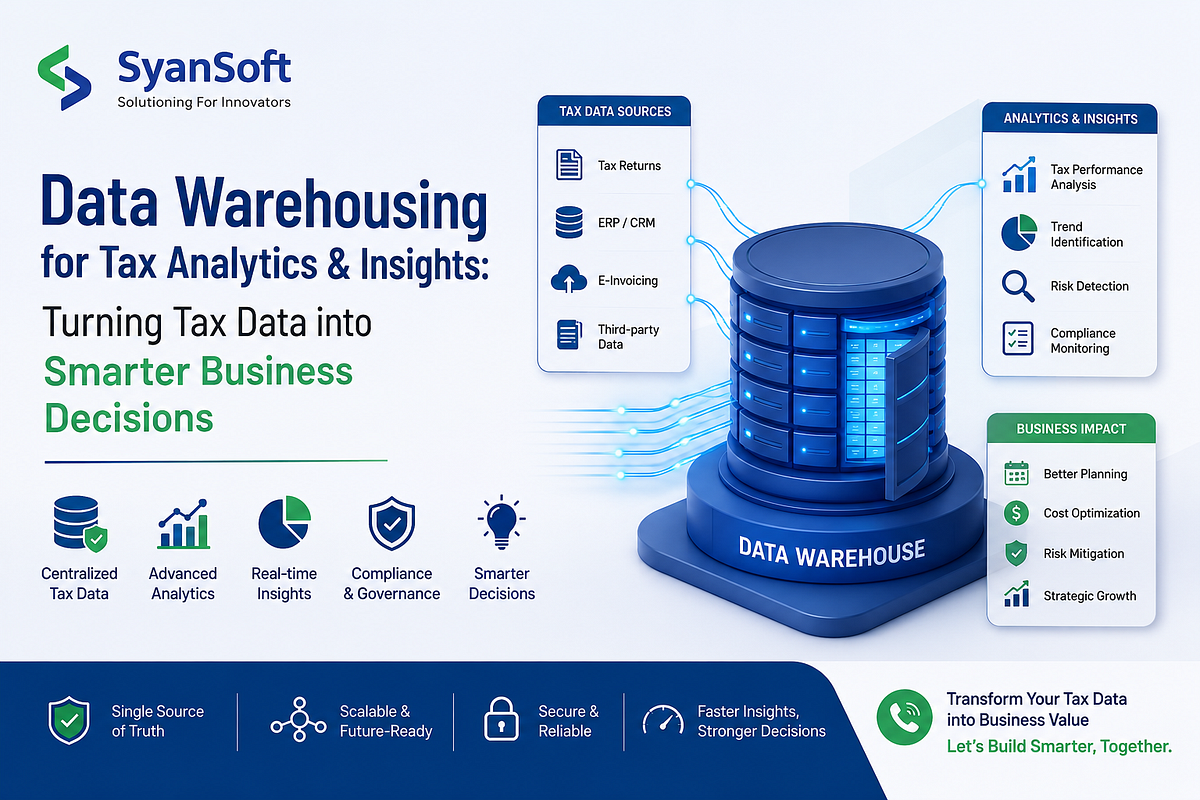
Tax data is growing more complex every year. Businesses need to manage data from ERP systems, accounting platforms, invoices, tax returns, compliance reports, and multiple business entities. When this information is scattered across systems, tax teams often struggle to get accurate insights quickly.
Data warehousing for tax analytics brings tax and financial data into a centralized, structured environment where businesses can analyze it, identify risks, improve compliance, and make faster decisions.
For organizations looking to modernize their tax function, a tax data warehouse can become the foundation for automated tax reporting, tax analytics, compliance monitoring, and strategic decision-making.
What Is Data Warehousing for Tax Analytics?
Data warehousing for tax analytics is the process of collecting, integrating, transforming, and storing tax-related data from multiple business systems in a centralized data warehouse.
A tax data warehouse can consolidate information from:
- ERP and accounting systems
- Tax management applications
- Invoicing and billing platforms
- General ledgers
- Accounts payable and receivable
- Sales and purchase transactions
- Tax returns and compliance records
- Customer and vendor data
- Business intelligence platforms
Once the data is centralized, tax teams can use analytics and reporting tools to identify trends, exceptions, compliance risks, and opportunities.
Why Do Businesses Need a Tax Data Warehouse?
Traditional tax reporting often depends on spreadsheets, manual data extraction, and disconnected applications. This can make tax analysis slow and difficult to scale.
A centralized tax data warehouse helps businesses create a single source of truth for tax information.
It can help organizations:
- Reduce manual data preparation
- Improve tax data accuracy
- Consolidate data from multiple systems
- Accelerate tax reporting
- Identify tax discrepancies
- Improve compliance visibility
- Support real-time or near-real-time analytics
- Create standardized tax reports
- Improve audit readiness
- Support strategic tax planning
How Does Tax Data Warehousing Work?
A typical tax analytics architecture involves several stages.
1. Data Collection
Tax and financial information is collected from ERP systems, accounting applications, billing platforms, databases, and other sources.
2. Data Integration
Data from different systems is integrated into a centralized environment. This helps eliminate isolated data silos.
3. Data Transformation
Raw data is cleaned, standardized, validated, and transformed into a consistent format.
For example, different systems may use different tax codes, entity names, currencies, or transaction classifications. Data transformation helps establish consistency.
4. Centralized Storage
The processed information is stored in a data warehouse where authorized users and analytics applications can access it.
5. Tax Analytics & Reporting
Business intelligence and analytics tools can then convert centralized data into dashboards, reports, alerts, and actionable insights.
What Tax Insights Can Businesses Get from a Data Warehouse?
A well-designed tax data warehouse can provide visibility into several areas of tax operations.
Tax Compliance Analytics
Businesses can monitor tax transactions, identify missing information, and detect unusual patterns before filing deadlines.
Tax Liability Analysis
Organizations can analyze tax liabilities across entities, jurisdictions, products, and transaction types.
Transaction-Level Tax Analysis
Businesses can examine transactions to identify incorrect tax calculations, unusual values, or potential compliance issues.
Tax Variance Analysis
Tax teams can compare current and historical data to identify unexpected changes in tax liabilities or reporting figures.
Audit & Risk Analytics
Centralized historical data can make it easier to investigate transactions, prepare supporting documentation, and respond to audit requirements.
Key Benefits of Data Warehousing for Tax Analytics
1. Better Tax Data Visibility
Instead of searching through multiple systems, tax professionals can access consolidated information from a centralized data environment.
2. Faster Reporting
Automated data pipelines can reduce the time required to collect and prepare information for tax reports.
3. Improved Data Accuracy
Standardized data processes can reduce errors caused by manual spreadsheet consolidation and inconsistent data sources.
4. Proactive Risk Detection
Analytics can help identify anomalies, missing data, unusual transactions, and potential compliance risks earlier.
5. Scalable Tax Operations
As businesses expand into new markets and jurisdictions, a centralized architecture can support growing transaction volumes and increasingly complex tax requirements.
6. Better Decision-Making
Tax analytics provides finance and tax leaders with data-driven insights instead of relying only on historical reports or manual analysis.
Data Warehousing vs. Traditional Tax Reporting
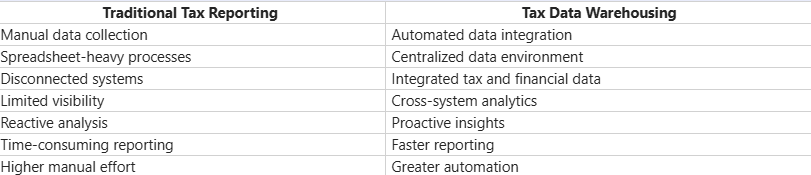
The goal is not simply to replace spreadsheets. The bigger opportunity is to create a connected tax data foundation that supports analytics, automation, compliance, and business intelligence.
How AI Can Improve Tax Data Analytics
Data warehousing provides the foundation, while AI can make tax analytics more intelligent.
AI-powered tax analytics can help businesses:
- Detect unusual transaction patterns
- Identify potential tax anomalies
- Automate data classification
- Forecast tax-related trends
- Prioritize high-risk transactions
- Generate analytical summaries
- Support tax professionals with natural-language queries
For example, instead of manually reviewing thousands of transactions, a tax team could use analytics to identify transactions that require further investigation.
What Should Businesses Consider Before Implementing a Tax Data Warehouse?
Successful tax data warehousing requires more than selecting a technology platform.
Businesses should consider:
Data quality: Poor-quality source data can produce unreliable analytics.
Integration: The warehouse should connect with ERP, finance, tax, and other relevant systems.
Security: Tax and financial data requires strong access controls and security practices.
Scalability: The architecture should support increasing transaction volumes and new jurisdictions.
Governance: Clear data ownership, validation rules, and governance processes are essential.
Reporting requirements: The data model should support both operational tax reporting and strategic analytics.
How SyanSoft Can Help With Tax Data Warehousing
SyanSoft Technologies helps businesses modernize their tax and data environments through technology-led solutions.
With the right data warehousing and tax analytics strategy, organizations can integrate tax information from multiple systems, improve data visibility, streamline reporting, and create a stronger foundation for advanced analytics.
Whether the requirement is tax data integration, cloud data warehousing, tax analytics, compliance reporting, or legacy tax application modernization, the focus should be on creating a scalable and reliable tax data ecosystem.
Ready to turn complex tax data into actionable business insights?
Talk to SyanSoft about building a smarter tax analytics and data warehousing strategy. Contact us for more information : https://www.syansoft.com/contact-us/

.jpg)

Comments
Post a Comment