AI & Machine Learning in Tax: Transforming Compliance, Reporting, and Tax Analytics
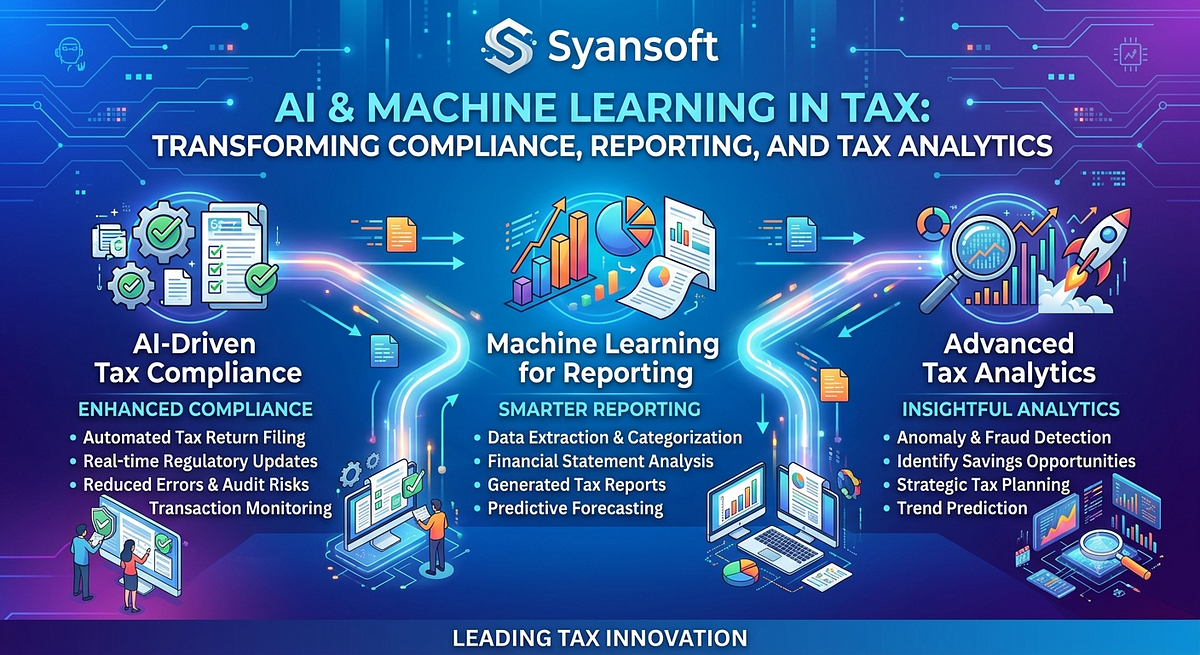
Tax functions are becoming increasingly data-driven. Businesses now manage large volumes of invoices, financial transactions, tax records, regulatory updates, and compliance requirements across multiple systems and jurisdictions. Traditional spreadsheets and manual processes can make tax operations time-consuming and increase the risk of errors.
AI and Machine Learning in Tax are helping enterprises move from manual tax processing to intelligent, automated, and data-driven tax management. From automated tax calculations and reconciliation to predictive analytics, anomaly detection, and tax research, AI can help finance and tax teams improve efficiency while gaining better visibility into tax risks and opportunities.
SyanSoft Technologies helps businesses explore AI-powered tax solutions that connect tax processes with ERP systems, data platforms, analytics, and automation technologies.
What Is AI and Machine Learning in Tax?
AI and Machine Learning in Tax refers to the use of artificial intelligence, machine learning algorithms, natural language processing, predictive analytics, and automation to improve tax-related processes.
Instead of relying entirely on manual data entry and rule-based workflows, AI systems can analyze large datasets, identify patterns, classify transactions, detect anomalies, and support tax-related decisions.
Businesses can use these technologies for:
- Automated tax data processing
- Tax calculation and classification
- Tax compliance monitoring
- Tax reconciliation
- Fraud and anomaly detection
- Predictive tax analytics
- Automated tax reporting
- Tax document analysis
- Regulatory research
- Audit preparation
SyanSoft’s existing AI and Machine Learning tax solutions focus on areas such as automated data processing, compliance and risk management, predictive analytics, indirect tax management, and smart audit and reconciliation.
How AI Is Transforming Tax Management
AI is changing tax operations by helping businesses process information faster and identify issues earlier.
1. Automated Tax Data Processing
Tax teams often work with invoices, receipts, ERP records, spreadsheets, and other structured and unstructured data. AI can help classify and validate this information before it moves into downstream tax processes.
This can reduce repetitive manual work and help tax teams focus on analysis and decision-making.
2. Intelligent Tax Compliance
AI-powered compliance systems can monitor tax data against defined rules and business requirements. They can flag unusual transactions, missing information, and potential compliance issues for review.
This creates a more proactive approach to tax compliance rather than relying only on periodic manual checks.
3. Predictive Tax Analytics
Machine learning can analyze historical and current financial data to identify patterns and support forecasting.
Businesses can use predictive tax analytics to:
- Forecast potential tax liabilities
- Analyze tax scenarios
- Identify trends
- Support tax planning
- Evaluate the potential impact of business transactions
SyanSoft also positions predictive analytics as part of its AI and Machine Learning tax capabilities for tax forecasting and strategic decision-making.
Key Use Cases of AI & Machine Learning in Tax
Automated Tax Calculations
AI-enabled tax systems can help automate calculations based on transaction data, tax rules, and configured business requirements. When integrated with ERP systems, tax calculations can become part of the existing financial workflow.
SyanSoft’s ERP tax integration capabilities include automated tax calculations and integrations with systems such as SAP, Oracle, Microsoft Dynamics, and QuickBooks.
Tax Reconciliation
Reconciling tax records across invoices, accounting systems, and tax reports can be time-consuming.
Machine learning and automation can help identify mismatches and exceptions, allowing finance teams to investigate discrepancies more efficiently.
Anomaly and Fraud Detection
Machine learning models can identify unusual transaction patterns that may require additional investigation.
For example, an AI system could flag transactions that differ significantly from historical patterns or configured expectations.
Automated Tax Reporting
AI and automation can help collect relevant data, validate records, organize tax information, and generate reports.
This can make tax reporting workflows more consistent and reduce dependency on manual spreadsheet-based processes.
AI-Powered Tax Research
Tax regulations and documentation can contain complex terminology and large amounts of information. Natural language processing can help tax professionals search, classify, and extract relevant information from tax documents.
AI Tax Chatbots
AI-powered tax assistants can help internal finance teams find information, answer common tax-related questions, support workflow requests, and improve access to tax knowledge.
Benefits of AI & Machine Learning in Tax
Improved Accuracy
Automating repetitive data processing and validation can reduce the risk of manual data-entry errors.
Faster Compliance Processes
Automation can reduce the amount of time spent collecting, classifying, reconciling, and preparing tax data.
Better Tax Risk Management
AI can help identify anomalies and potential compliance issues earlier, allowing teams to investigate them before they become larger problems.
Real-Time Visibility
AI-powered dashboards and analytics can provide finance leaders with more timely information for monitoring tax performance and compliance.
Better Decision-Making
Predictive analytics can help organizations evaluate tax scenarios and make more informed financial decisions.
Scalable Tax Operations
AI-powered tax systems can support growing transaction volumes and increasingly complex tax environments when designed with scalable architecture.
AI-Powered Tax Compliance with ERP Integration
One of the biggest opportunities for enterprises is connecting AI-powered tax solutions with existing ERP and financial systems.
ERP integration can bring together:
ERP Data → AI/ML Models → Tax Rules → Validation → Reconciliation → Reporting → Analytics
This connected approach can help businesses reduce data silos and create a more consistent tax workflow.
SyanSoft’s ERP tax integration offering focuses on automation, real-time compliance, AI-driven validation, predictive analytics, anomaly detection, reconciliation, and integration with major ERP platforms.
AI in GST, VAT, and Indirect Tax Management
Indirect tax management can become particularly complex for organizations operating across multiple markets.
AI can support areas such as:
- Transaction classification
- Tax determination
- Tax-rate validation
- GST/VAT analysis
- Transaction monitoring
- Reconciliation
- Exception detection
- Compliance reporting
For organizations operating across jurisdictions, AI-powered tax systems can provide a foundation for more centralized and automated tax operations.
AI and Machine Learning for Tax Audit Readiness
Audit preparation often requires finance teams to gather supporting documents, reconcile records, identify discrepancies, and provide an accurate trail of transactions.
AI-powered reconciliation and monitoring can help maintain more organized records throughout the year rather than preparing everything only when an audit occurs.
A continuous approach can support:
- Automated reconciliation
- Exception identification
- Audit trails
- Transaction monitoring
- Document classification
- Reporting and analytics
SyanSoft highlights smart audit and reconciliation tools as part of its AI and Machine Learning tax capabilities.
Challenges of Implementing AI in Tax
AI can create significant opportunities, but successful implementation requires more than deploying a machine learning model.
Businesses should consider:
Data Quality
AI models depend on reliable and consistent data. Poor-quality tax or financial data can reduce the effectiveness of automated workflows.
Integration
Tax systems need to work with existing ERP, accounting, CRM, payroll, and other business systems.
Security and Privacy
Tax and financial data are sensitive. Organizations need appropriate security, access controls, governance, and data-protection practices.
Explainability
Tax professionals need to understand why an AI system flagged a transaction or produced a particular recommendation.
Human Oversight
AI should support tax professionals rather than eliminate appropriate human review. High-impact tax decisions should have suitable validation and governance.
The Future of AI in Tax
The future of tax management is moving toward increasingly connected, automated, and intelligent systems.
Organizations are exploring technologies such as:
- Generative AI for tax knowledge management
- AI tax copilots
- Predictive tax analytics
- Intelligent document processing
- Automated compliance monitoring
- Real-time tax reporting
- AI-powered tax dashboards
- Machine learning-based anomaly detection
- API-driven tax and ERP integrations
SyanSoft’s tax technology portfolio includes AI and Machine Learning for Tax, ERP tax integration, tax analytics, and automated tax compliance and reporting, creating opportunities to build connected tax technology ecosystems.
Why Choose SyanSoft for AI & Machine Learning in Tax?
SyanSoft combines AI, machine learning, tax technology, data, and enterprise integration to help businesses modernize tax processes.
Its AI and Machine Learning in Tax offering includes areas such as AI-based tax data lakes and warehousing, intelligent compliance management, customized machine learning models, predictive tax planning, ERP and regulatory-system integrations, and AI-powered dashboards and analytics.
The company also provides broader tax technology services covering tax engine implementation, ERP integration, tax data analytics, tax risk management, and modernization of legacy tax applications.
Conclusion
AI & Machine Learning in Tax are moving tax management beyond manual processing toward intelligent automation, predictive analytics, and continuous compliance monitoring.
From automated tax reporting and reconciliation to ERP integration, anomaly detection, predictive tax analytics, and AI-powered tax assistants, organizations can use AI to create more efficient and data-driven tax operations.
For enterprises looking to modernize their tax technology ecosystem, SyanSoft can help design and integrate AI-powered tax solutions aligned with existing business systems and tax workflows.
Ready to modernize your tax operations with AI? Explore SyanSoft’s AI & Machine Learning in Tax solutions and identify the right automation opportunities for your business.

.jpg)

Comments
Post a Comment