Custom AI & Machine Learning Models for Enterprise Business Needs
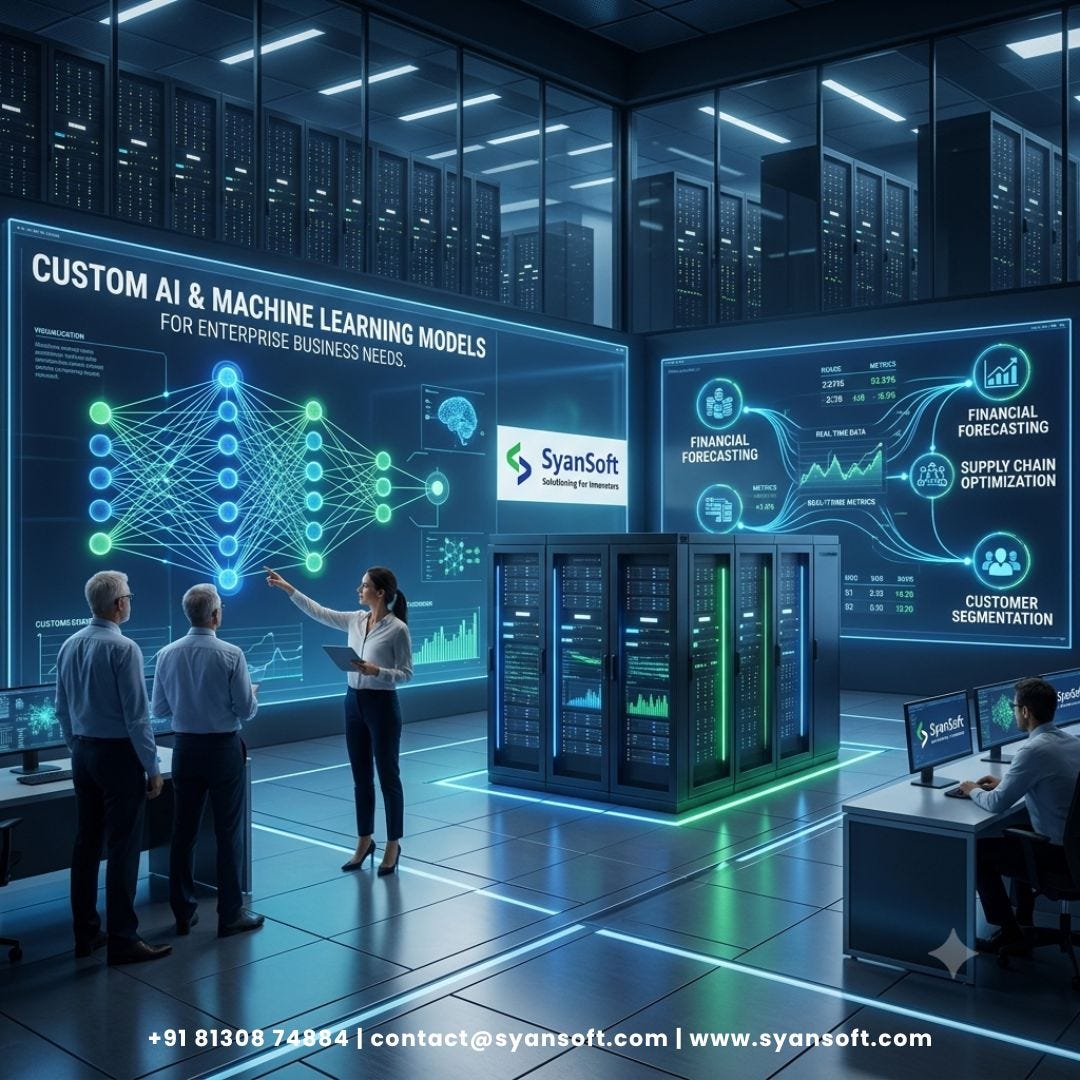
As enterprises generate more data and manage increasingly complex operations, generic AI tools are often not enough to solve specific business challenges. Organizations need AI systems that understand their data, workflows, industry requirements, and business objectives.
Custom AI and Machine Learning (ML) models help enterprises build this type of purpose-driven intelligence. Instead of relying only on pre-built models, businesses can develop or customize AI solutions for predictive analytics, automation, fraud detection, customer intelligence, recommendation systems, document processing, and operational decision-making.
SyanSoft Technologies offers custom AI and machine learning solutions designed around enterprise requirements, including model development, optimization, deployment, and integration with existing business systems.
What Are Custom AI and Machine Learning Models?
Custom AI and ML models are intelligent systems developed or adapted for a specific business use case, dataset, industry, or workflow.
Unlike generic AI applications, custom models can be trained or configured around an organization’s own:
- Business data
- Operational processes
- Customer behavior
- Industry requirements
- Business rules
- Performance objectives
- Enterprise applications
For example, a retailer may need a demand forecasting model, while a financial organization may require fraud detection and risk prediction. A manufacturer could use machine learning for predictive maintenance, while an enterprise service provider may need intelligent document classification.
The objective is not simply to “add AI,” but to create a model that solves a measurable business problem.
Why Enterprises Need Custom AI Models
Off-the-shelf AI tools can provide valuable capabilities, but they may not understand an organization’s proprietary data or specialized workflows.
Custom AI models can help enterprises:
Improve Decision-Making
Machine learning can identify patterns across large datasets and generate predictions that support faster, data-driven decisions.
Automate Repetitive Processes
AI can automate classification, forecasting, document processing, anomaly detection, and other repetitive activities.
Improve Customer Experiences
AI models can analyze customer behavior and preferences to support personalization, recommendations, intelligent search, and automated customer support.
Detect Risks and Anomalies
ML models can identify unusual patterns in transactions, operations, or user behavior and help organizations respond to potential risks earlier.
Scale Business Intelligence
Instead of depending entirely on manual analysis, enterprises can use AI to continuously process large volumes of structured and unstructured data.
Key Types of Custom AI & ML Models for Enterprises
Different business objectives require different approaches. SyanSoft’s AI and machine learning capabilities cover areas including predictive models, NLP, computer vision, custom AI applications, and enterprise AI integration.
1. Predictive Analytics Models
Predictive models use historical and real-time data to identify patterns and estimate potential future outcomes.
Enterprise use cases include:
- Demand forecasting
- Sales forecasting
- Customer churn prediction
- Risk prediction
- Predictive maintenance
- Revenue forecasting
- Inventory optimization
2. Natural Language Processing Models
NLP models help businesses process and understand human language.
They can support:
- Intelligent chatbots
- Enterprise search
- Document classification
- Sentiment analysis
- Text extraction
- Customer feedback analysis
- Knowledge management
3. Computer Vision Models
Computer vision enables software to interpret images and video.
Potential enterprise applications include:
- Quality inspection
- Object detection
- Image classification
- Document processing
- Visual monitoring
- Facial recognition
- Manufacturing inspection
4. Recommendation Models
Recommendation engines analyze customer or user behavior to provide relevant products, services, content, or actions.
They can be applied to:
- E-commerce
- Financial services
- Media platforms
- Enterprise knowledge systems
- Customer portals
5. Anomaly and Fraud Detection Models
Machine learning can identify patterns that differ from normal business behavior.
Organizations can use these models for:
- Fraud detection
- Transaction monitoring
- Cybersecurity analytics
- Operational anomaly detection
- Compliance monitoring
- Risk management
Custom AI Model Development Process
Building an enterprise AI model requires more than selecting an algorithm. Data quality, business objectives, integration, security, and ongoing monitoring all influence the final outcome.
Step 1: Business and AI Readiness Assessment
The process begins by understanding the business problem, available data, existing technology infrastructure, and expected outcomes.
SyanSoft’s AI approach includes evaluating business requirements and data architecture before selecting suitable AI use cases and models. (SyanSoft Technologies)
Step 2: Data Collection and Preparation
Enterprise data may come from:
- ERP systems
- CRM platforms
- Data warehouses
- APIs
- Applications
- Documents
- IoT devices
- Customer interactions
The data may need to be cleaned, transformed, labeled, and structured before training.
Step 3: Model Selection
The appropriate model depends on the business problem and data.
Depending on the use case, teams may evaluate:
- Machine learning algorithms
- Deep learning models
- NLP models
- Computer vision models
- Transformer architectures
- Predictive models
SyanSoft’s custom model development work includes technologies such as TensorFlow, PyTorch, and Scikit-learn.
Step 4: Training and Validation
The model is trained using relevant datasets and evaluated against defined performance metrics.
Validation helps determine whether the model is producing reliable results and whether it can generalize beyond its training data.
Step 5: Integration
An AI model becomes significantly more valuable when it is connected to the systems where employees and customers already work.
SyanSoft supports AI integration with enterprise environments such as ERP, CRM, data platforms, and custom applications through APIs and integration pipelines. (SyanSoft Technologies)
Step 6: Deployment and Monitoring
After deployment, models need continuous monitoring to identify performance changes, data drift, latency issues, and other problems.
Ongoing optimization can help keep enterprise AI systems useful as business data and requirements evolve.
Enterprise AI Use Cases Across Industries
Custom AI and ML models can be adapted to different business environments.
Financial Services
- Fraud detection
- Credit risk prediction
- Customer segmentation
- Transaction monitoring
- Financial forecasting
Manufacturing
- Predictive maintenance
- Quality inspection
- Demand forecasting
- Supply chain optimization
- Production analytics
Retail and E-commerce
- Product recommendations
- Customer churn prediction
- Demand forecasting
- Dynamic personalization
- Customer sentiment analysis
Healthcare
- Medical document processing
- Predictive analytics
- Patient risk analysis
- Workflow automation
- Image analysis
Tax and Finance
- Tax anomaly detection
- Automated classification
- Compliance analytics
- Financial forecasting
- Tax data analysis
Enterprise Operations
- Intelligent document processing
- Workflow automation
- Employee assistance
- Enterprise search
- Business intelligence
Custom AI Models vs. Off-the-Shelf AI
Custom AI & ML ModelsOff-the-Shelf AIDesigned for specific business requirementsDesigned for broad use casesCan use proprietary enterprise dataUsually limited to general capabilitiesGreater control over workflowsFaster initial implementationCan be optimized for specific metricsStandardized functionalityCan integrate deeply with enterprise systemsIntegration capabilities varySuitable for specialized use casesSuitable for common use cases
The right choice depends on the organization’s objectives. In some cases, integrating an existing AI model is more practical; in others, customization or model development can provide greater business value.
How SyanSoft Helps Enterprises Build Custom AI Models
SyanSoft approaches AI development around the business problem rather than treating the model as the end goal.
Its AI and ML capabilities include AI strategy and consulting, custom AI applications, predictive analytics, machine learning consulting, enterprise AI development, model customization, and integration with existing systems.
For organizations exploring generative AI, SyanSoft also provides custom LLM development and model fine-tuning, allowing enterprises to adapt AI systems to domain-specific information and workflows.
Security and Scalability for Enterprise AI
Enterprise AI systems often process sensitive business information, making security and governance important parts of implementation.
A production-ready AI architecture should consider:
- Data privacy
- Access controls
- Model monitoring
- Secure APIs
- Auditability
- Compliance requirements
- Human oversight
- Cloud or on-premise deployment requirements
SyanSoft’s enterprise AI offerings include cloud and on-premise deployment options and emphasize secure integration with existing enterprise environments
What Should Enterprises Consider Before Building an AI Model?
Before investing in custom AI development, businesses should answer five questions:
- What business problem are we solving?
- Do we have enough reliable data?
- What measurable outcome will define success?
- How will the model integrate with existing systems?
- How will we monitor and improve the model after deployment?
Starting with a focused use case or proof of concept can help organizations validate technical feasibility and business value before scaling an AI initiative.
The Future of Custom Enterprise AI
Enterprise AI is moving from experimental projects toward AI systems embedded directly into business workflows. Predictive models, intelligent automation, AI copilots, custom LLMs, and machine learning applications can increasingly work alongside existing enterprise platforms.
The long-term advantage will not simply come from using the newest AI model. It will come from connecting AI with proprietary business data, processes, domain knowledge, and measurable business objectives.
For enterprises, custom AI and machine learning models can provide a practical path toward smarter automation, predictive decision-making, personalized experiences, and more efficient operations.
Conclusion
Custom AI and Machine Learning models allow enterprises to move beyond generic AI tools and develop intelligence around their actual business requirements. From predictive analytics and fraud detection to NLP, computer vision, recommendations, and intelligent automation, custom models can address specialized challenges across industries.
With capabilities spanning AI strategy, custom model development, machine learning consulting, enterprise integration, and AI optimization, SyanSoft Technologies can help businesses move from an AI idea to a production-ready solution.

.jpg)

Comments
Post a Comment