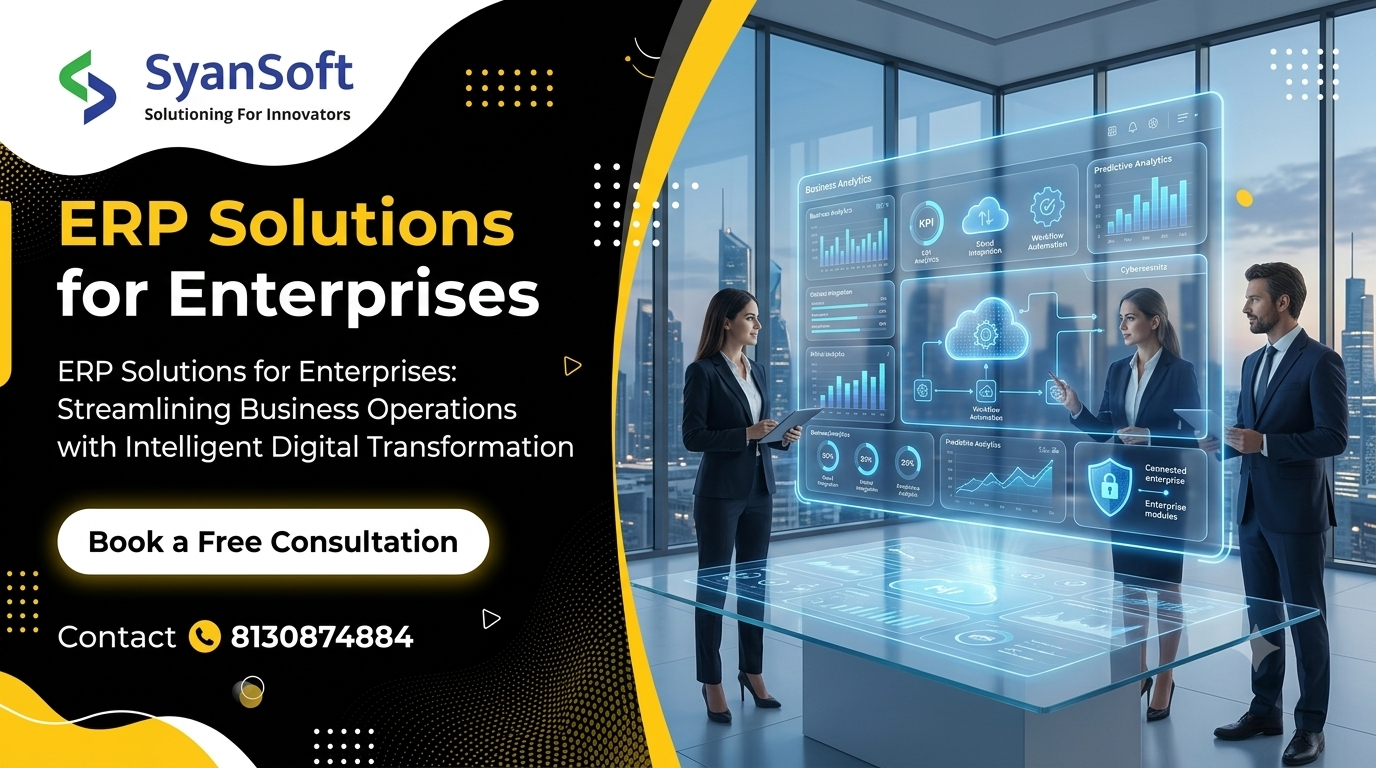
ERP Solutions for Enterprises: Streamlining Business Operations with Intelligent Digital Transformation
In today's fast-paced business environment, enterprises must manage multiple functions such as finance, human resources, procurement, inventory, sales, customer relationships, and supply chain operations. Handling these processes through disconnected systems often leads to inefficiencies, data silos, and delayed decision-making. This is where Enterprise Resource Planning (ERP) Solutions become a game-changer.
ERP solutions integrate core business processes into a single, centralized platform, enabling organizations to automate workflows, improve collaboration, and gain real-time insights across departments. Modern ERP systems also leverage emerging technologies such as Artificial Intelligence (AI), Machine Learning (ML), cloud computing, and advanced analytics to drive smarter business decisions and sustainable growth.
In this blog, we'll explore the importance of ERP solutions, their key features, benefits, implementation process, industry applications, emerging trends, and how SyanSoft Technologies delivers customized ERP solutions for enterprises.
What Are ERP Solutions?
Enterprise Resource Planning (ERP) is an integrated software system that helps organizations manage and automate their core business operations through a centralized platform. Instead of using separate applications for finance, HR, inventory, sales, and procurement, ERP connects these functions, ensuring seamless data flow and improved operational efficiency.
An ERP solution typically includes modules for:
- Finance & Accounting
- Human Resource Management (HRM)
- Inventory Management
- Procurement & Purchasing
- Sales & Customer Relationship Management (CRM)
- Supply Chain Management
- Manufacturing
- Project Management
- Business Intelligence & Reporting
- Compliance & Risk Management
By providing a unified view of business operations, ERP empowers enterprises to make informed decisions and improve overall performance.
Why Enterprises Need ERP Solutions
As businesses grow, managing operations across multiple departments becomes increasingly complex. ERP systems eliminate manual processes and fragmented data, helping organizations operate more efficiently.
Key reasons to adopt ERP solutions include:
- Centralize business data
- Automate repetitive workflows
- Improve collaboration across departments
- Enhance financial visibility
- Optimize inventory and supply chain
- Increase employee productivity
- Support regulatory compliance
- Enable real-time decision-making
- Improve customer satisfaction
- Scale operations with business growth
Key Features of Enterprise ERP Solutions
Centralized Data Management
ERP creates a single source of truth by consolidating data from various departments into one platform.
Financial Management
Manage:
- General ledger
- Accounts payable
- Accounts receivable
- Budgeting
- Tax management
- Financial reporting
This ensures greater financial accuracy and transparency.
Human Resource Management
HR modules support:
- Employee records
- Payroll processing
- Attendance tracking
- Leave management
- Recruitment
- Performance evaluation
Inventory & Warehouse Management
Track inventory levels, warehouse movements, stock availability, and reorder points in real time.
Procurement Management
Automate procurement activities, including:
- Vendor management
- Purchase requisitions
- Purchase orders
- Invoice processing
Sales & CRM Integration
ERP integrates sales and customer management processes to improve lead tracking, order management, and customer service.
Supply Chain Management
Optimize logistics, production planning, supplier collaboration, and demand forecasting for a more efficient supply chain.
Analytics & Reporting
Generate real-time dashboards and reports that provide actionable business insights for executives and managers.
Benefits of ERP Solutions for Enterprises
Improved Operational Efficiency
ERP automates repetitive tasks, reducing manual effort and improving productivity across departments.
Better Decision-Making
Access to real-time data enables leadership teams to make informed strategic decisions.
Enhanced Collaboration
Departments work from the same data, improving communication and reducing duplication.
Increased Data Accuracy
Centralized information minimizes errors caused by duplicate or outdated records.
Cost Savings
ERP reduces operational expenses by streamlining processes and improving resource utilization.
Business Scalability
Modern ERP platforms grow alongside your organization, supporting additional users, locations, and business units.
ERP Implementation Process
1. Business Analysis
Evaluate current business processes, identify challenges, and define ERP objectives.
2. Solution Design
Design an ERP architecture tailored to organizational needs, workflows, and industry requirements.
3. System Configuration
Configure ERP modules, user roles, workflows, and business rules based on operational needs.
4. Data Migration
Transfer existing business data into the new ERP system while ensuring accuracy and consistency.
5. Integration
Connect ERP with existing applications such as CRM, HRMS, accounting software, cloud platforms, and third-party systems.
6. Testing
Conduct comprehensive testing to validate system performance, functionality, and security before deployment.
7. Training & Deployment
Train employees, roll out the ERP system, and provide post-implementation support for successful adoption.
Emerging ERP Trends
Cloud ERP
Cloud-based ERP solutions offer greater flexibility, scalability, and lower infrastructure costs.
AI-Powered ERP
Artificial Intelligence enhances ERP with predictive analytics, intelligent automation, and decision support.
Generative AI Integration
Generative AI assists with report generation, document creation, customer support, and enterprise knowledge management.
Mobile ERP
Mobile applications enable employees to access ERP data anytime, anywhere.
IoT Integration
Internet of Things (IoT) devices provide real-time operational data for inventory, manufacturing, and logistics.
Advanced Analytics
Business intelligence tools deliver predictive insights for planning, forecasting, and performance optimization.
Best Practices for Successful ERP Implementation
To maximize ERP success:
- Clearly define business goals
- Choose the right ERP platform
- Involve key stakeholders early
- Ensure data quality before migration
- Train employees thoroughly
- Customize only where necessary
- Monitor system performance continuously
- Plan for future scalability
- Maintain strong cybersecurity measures
- Partner with an experienced ERP implementation provider
Why Choose SyanSoft Technologies for ERP Solutions?
At SyanSoft Technologies, we help enterprises modernize operations with customized ERP solutions designed to improve efficiency, visibility, and business performance.
Our ERP services include:
- ERP Consulting & Strategy
- Custom ERP Development
- ERP Implementation
- ERP Migration & Modernization
- Cloud ERP Solutions
- ERP Integration
- AI-Enabled ERP Development
- ERP Maintenance & Support
- Business Process Automation
- Analytics & Reporting Solutions
Our team combines deep technical expertise with industry knowledge to deliver secure, scalable, and future-ready ERP platforms tailored to your unique business requirements.
Conclusion
ERP solutions are the backbone of modern enterprise operations, enabling organizations to unify processes, improve collaboration, and make data-driven decisions. By integrating finance, HR, supply chain, sales, inventory, and analytics into a single platform, businesses can reduce complexity, enhance efficiency, and accelerate digital transformation.
Whether you're modernizing legacy systems or implementing a new ERP platform, SyanSoft Technologies provides end-to-end ERP solutions that empower enterprises to achieve operational excellence and long-term growth.

.jpg)

Comments
Post a Comment