ERP Solutions for Enterprises: Streamlining Business Operations for Sustainable Growth
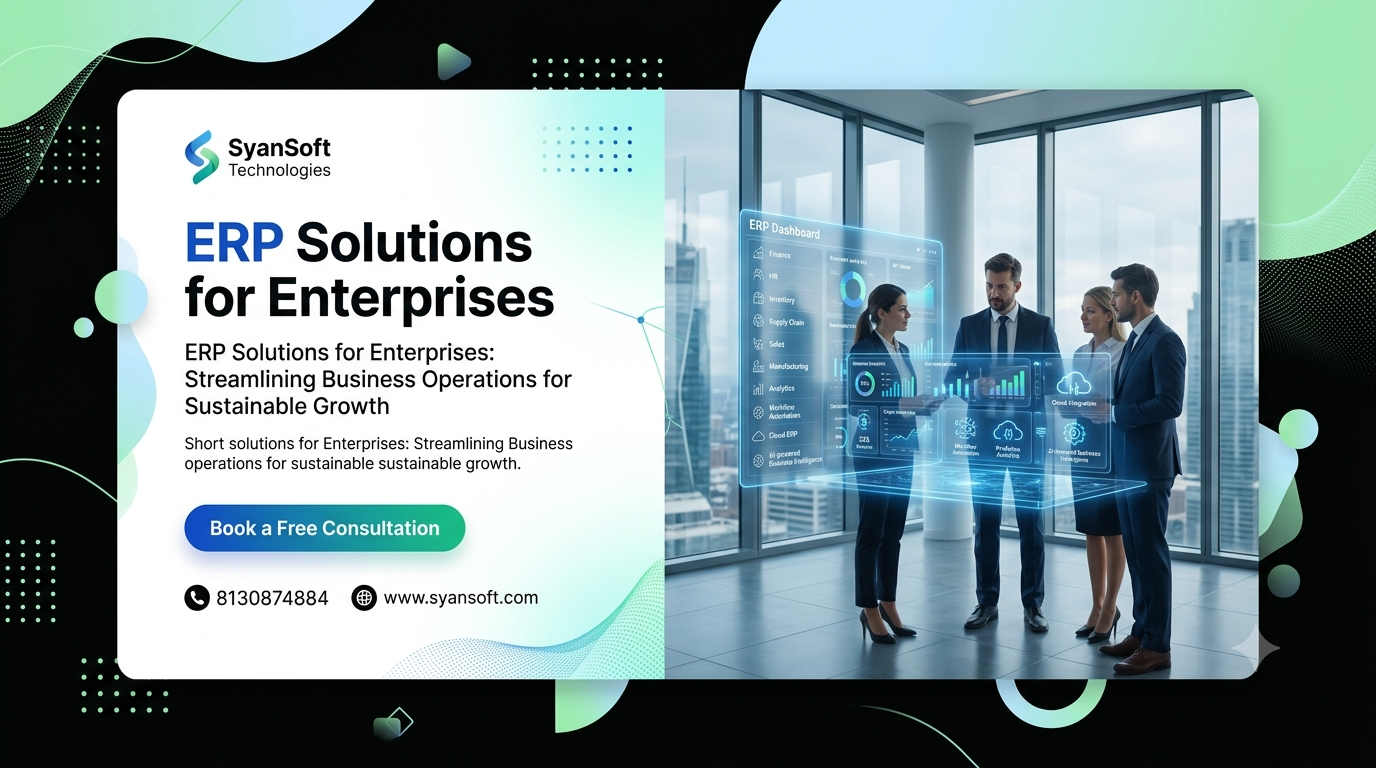
In today's fast-paced business environment, enterprises manage vast amounts of data, multiple departments, and complex workflows. From finance and human resources to inventory, procurement, and customer relationship management, every function plays a critical role in organizational success. Managing these operations through disconnected systems often leads to inefficiencies, data inconsistencies, and delayed decision-making.
Enterprise Resource Planning (ERP) solutions address these challenges by integrating core business processes into a single, centralized platform. By providing real-time visibility, automation, and seamless collaboration across departments, ERP systems empower organizations to improve operational efficiency, reduce costs, and support long-term growth.
What Are ERP Solutions?
ERP (Enterprise Resource Planning) solutions are integrated software platforms that connect various business functions within an organization. Instead of relying on separate applications for finance, sales, procurement, inventory, manufacturing, and human resources, an ERP system brings all critical operations together in one unified environment.
This centralized approach ensures that departments share accurate, up-to-date information, enabling faster collaboration and more informed business decisions.
Why Enterprises Need ERP Solutions
As organizations expand, managing operations manually or through multiple disconnected systems becomes increasingly difficult. Common challenges include:
- Data duplication across departments
- Limited visibility into business performance
- Manual and repetitive processes
- Delayed reporting and decision-making
- Inventory inaccuracies
- Compliance and security concerns
- Difficulty scaling operations
ERP solutions eliminate these obstacles by streamlining workflows and improving communication across the organization.
Key Features of ERP Solutions
Centralized Data Management
ERP systems provide a single source of truth where business information is stored securely and accessed in real time. This reduces errors and ensures consistency across departments.
Financial Management
Modern ERP platforms simplify financial operations by automating:
- General ledger management
- Accounts payable and receivable
- Budget planning
- Tax reporting
- Financial forecasting
- Expense tracking
This improves financial accuracy and regulatory compliance.
Human Resource Management
ERP solutions help HR teams efficiently manage:
- Employee records
- Payroll processing
- Leave management
- Recruitment
- Performance evaluations
- Training programs
Automation reduces administrative workload while improving employee experiences.
Inventory and Supply Chain Management
Businesses gain better control over inventory through:
- Real-time stock monitoring
- Warehouse management
- Demand forecasting
- Procurement automation
- Supplier management
- Order tracking
This minimizes stock shortages and reduces carrying costs.
Sales and Customer Management
ERP systems often integrate customer relationship management (CRM) capabilities, enabling businesses to:
- Track customer interactions
- Manage sales pipelines
- Process orders efficiently
- Improve customer service
- Generate accurate sales reports
This leads to stronger customer relationships and higher revenue opportunities.
Manufacturing and Production Planning
For manufacturing enterprises, ERP solutions support:
- Production scheduling
- Material requirement planning
- Quality management
- Equipment maintenance
- Shop floor monitoring
- Production cost analysis
These capabilities improve productivity and reduce operational waste.
Benefits of ERP Solutions for Enterprises
Improved Operational Efficiency
Automation reduces repetitive manual tasks, allowing employees to focus on strategic initiatives.
Better Decision-Making
Real-time dashboards and analytics provide executives with accurate insights into business performance, enabling faster and more informed decisions.
Increased Productivity
Employees spend less time switching between systems and more time completing high-value work.
Enhanced Collaboration
Since all departments access the same data, communication improves and information flows more efficiently across teams.
Cost Reduction
ERP solutions help organizations reduce operational expenses by optimizing resource utilization, improving inventory management, and minimizing errors.
Greater Business Agility
Modern ERP platforms allow enterprises to adapt quickly to changing market conditions, customer demands, and business opportunities.
Cloud ERP vs. On-Premises ERP
Cloud ERP
Cloud-based ERP solutions offer:
- Lower infrastructure costs
- Automatic software updates
- Remote accessibility
- Faster deployment
- Flexible scalability
- Enhanced disaster recovery
These benefits make cloud ERP an increasingly popular choice for modern enterprises.
On-Premises ERP
On-premises ERP systems provide:
- Greater infrastructure control
- Customized security policies
- Internal server management
- Compliance with specific regulatory requirements
Organizations with specialized operational needs may prefer this deployment model.
Emerging Trends in ERP Solutions
ERP technology continues to evolve with advanced capabilities such as:
- Artificial Intelligence for predictive insights
- Machine Learning for process optimization
- Robotic Process Automation (RPA)
- Internet of Things (IoT) integration
- Advanced business intelligence dashboards
- Mobile ERP applications
- Predictive analytics
- Low-code customization
- Blockchain-enabled supply chain transparency
These innovations help enterprises become more intelligent, agile, and competitive.
Best Practices for ERP Implementation
Successful ERP implementation requires careful planning. Organizations should:
- Clearly define business objectives
- Analyze existing workflows
- Involve stakeholders from every department
- Choose scalable ERP solutions
- Ensure data accuracy before migration
- Provide employee training
- Monitor performance after deployment
- Continuously optimize business processes
A well-executed implementation maximizes return on investment and accelerates digital transformation.
Why Choose a Professional ERP Development Partner?
Implementing an ERP solution is a strategic investment that requires technical expertise and industry knowledge. An experienced ERP development partner can:
- Assess business requirements
- Design customized ERP solutions
- Integrate existing systems
- Ensure secure data migration
- Provide user training
- Offer ongoing maintenance and support
- Scale the solution as business needs evolve
Conclusion
ERP solutions have become an essential foundation for modern enterprises seeking operational excellence, improved collaboration, and sustainable growth. By integrating business processes into a unified platform, organizations can automate routine tasks, enhance decision-making, and gain real-time visibility into every aspect of their operations.
As businesses continue their digital transformation journey, investing in a scalable and intelligent ERP solution enables them to improve efficiency, adapt to changing market demands, and remain competitive in an increasingly dynamic business landscape. A thoughtfully implemented ERP system is not just a technology upgrade—it is a strategic asset that empowers enterprises to achieve long-term success
.jpg)


Comments
Post a Comment