Enterprise GenAI Implementation: Transforming Business Operations with Generative AI at Scale
Generative Artificial Intelligence (GenAI) is revolutionizing the way enterprises operate, innovate, and deliver value to customers. From automating complex workflows and enhancing customer experiences to accelerating software development and improving decision-making, GenAI is becoming a strategic asset for organizations worldwide.
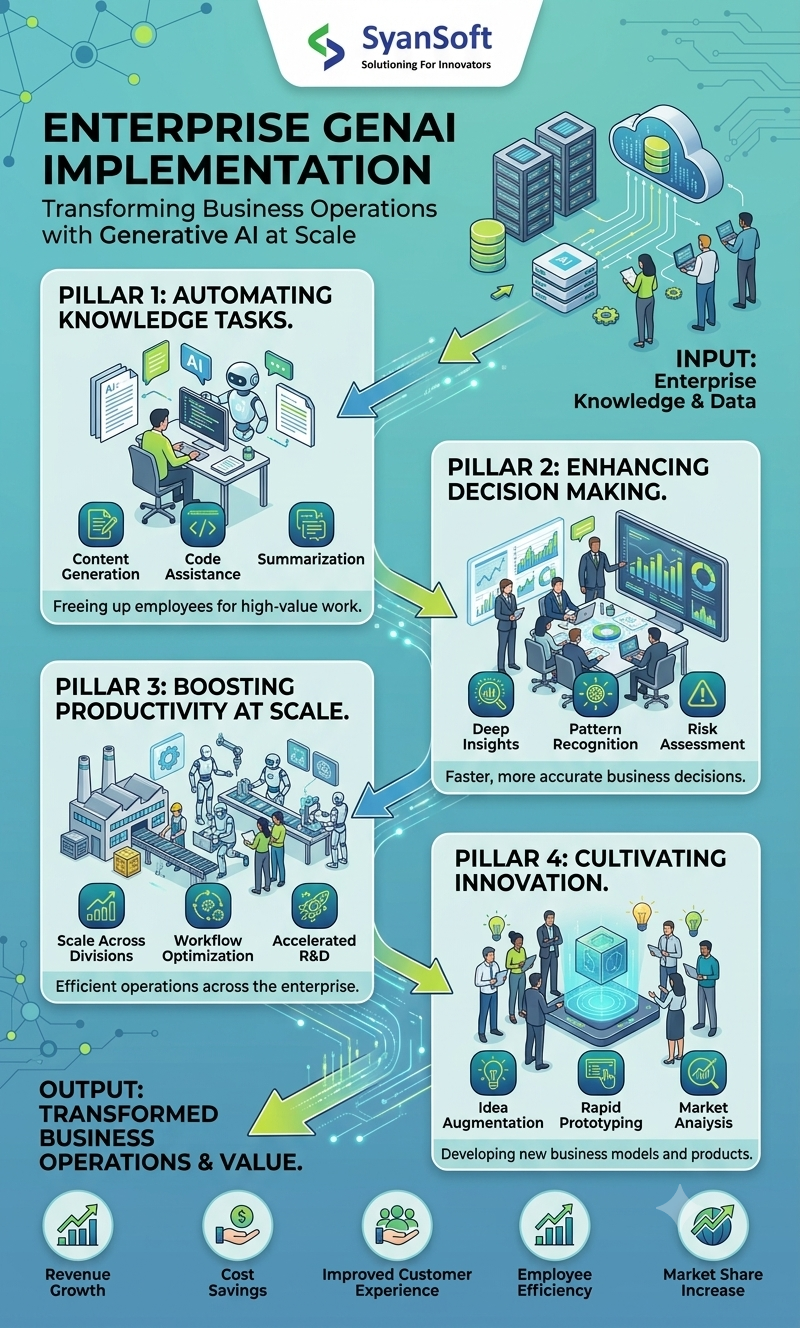
However, implementing GenAI at an enterprise level requires more than simply deploying AI models. It involves a well-planned strategy, robust infrastructure, governance frameworks, data management, and continuous optimization. Organizations that successfully implement Enterprise GenAI can unlock unprecedented levels of productivity, efficiency, and innovation.
This article explores the key aspects of Enterprise GenAI implementation, its benefits, challenges, and best practices for achieving sustainable business success.
What is Enterprise GenAI?
Enterprise Generative AI refers to the deployment of advanced AI models, such as Large Language Models (LLMs), multimodal AI systems, and domain-specific generative solutions, across business functions and organizational processes.
Unlike consumer AI applications, Enterprise GenAI focuses on:
- Business-specific use cases
- Secure and compliant AI deployment
- Integration with enterprise systems
- Scalable AI infrastructure
- Governance and risk management
- Industry-specific customization
Enterprise GenAI empowers organizations to generate content, automate processes, analyze data, create software code, and support intelligent decision-making at scale.
Why Enterprises are Investing in GenAI
Businesses across industries are adopting GenAI because it delivers measurable value in multiple areas:
Increased Productivity
AI-powered automation significantly reduces repetitive tasks, allowing employees to focus on strategic and creative initiatives.
Enhanced Customer Experience
GenAI enables personalized interactions, intelligent chatbots, virtual assistants, and faster customer support.
Faster Innovation
Organizations can accelerate product development, research, content creation, and software engineering through AI-assisted workflows.
Improved Decision-Making
AI models can analyze large datasets, identify patterns, and provide actionable insights to support business decisions.
Cost Optimization
Automating manual processes reduces operational expenses and increases resource efficiency.
Key Components of Enterprise GenAI Implementation
Successful implementation requires a structured approach involving multiple components.
1. AI Strategy Development
Organizations should establish clear objectives before implementing GenAI.
Key considerations include:
- Business goals
- Target use cases
- Expected ROI
- Risk assessment
- Compliance requirements
A strong strategy ensures AI initiatives align with broader organizational objectives.
2. Data Readiness
High-quality data is the foundation of successful AI systems.
Organizations must:
- Consolidate data sources
- Ensure data accuracy
- Remove duplicates
- Establish governance policies
- Protect sensitive information
Well-prepared data improves model performance and reliability.
3. Model Selection
Enterprises can choose from:
- Public foundation models
- Open-source LLMs
- Industry-specific AI models
- Custom-trained AI solutions
The selection depends on factors such as security, scalability, performance, and business requirements.
4. Infrastructure and Scalability
Enterprise AI workloads require robust infrastructure.
Organizations should evaluate:
- Cloud-based deployment
- Hybrid environments
- On-premises solutions
- GPU resources
- AI orchestration platforms
Scalable infrastructure supports future growth and increasing AI demands.
5. Security and Governance
Security remains a top priority for enterprise AI adoption.
Essential measures include:
- Data encryption
- Access control
- Audit trails
- Regulatory compliance
- Responsible AI practices
A comprehensive governance framework ensures ethical and secure AI deployment.
Enterprise GenAI Use Cases
Customer Service Automation
AI-powered virtual assistants provide instant responses, resolve common issues, and improve customer satisfaction while reducing support costs.
Software Development
Generative AI assists developers with:
- Code generation
- Bug detection
- Documentation creation
- Test automation
- Code optimization
This accelerates software delivery and improves development efficiency.
Knowledge Management
Organizations can create intelligent knowledge bases that allow employees to quickly access relevant information through natural language queries.
Marketing and Content Creation
GenAI helps businesses generate:
- Blog articles
- Social media content
- Marketing campaigns
- Product descriptions
- Personalized communications
This enables faster content production and improved audience engagement.
Sales Enablement
Sales teams use AI to generate proposals, summarize customer interactions, identify opportunities, and personalize outreach efforts.
Human Resources
GenAI streamlines recruitment, onboarding, employee support, training, and performance management processes.
Challenges in Enterprise GenAI Adoption
While GenAI offers significant benefits, organizations may encounter several challenges.
Data Privacy Concerns
Sensitive business information must be protected during AI training and deployment.
Integration Complexity
Connecting AI solutions with existing enterprise systems can be technically demanding.
Model Accuracy
AI-generated outputs require validation to ensure reliability and reduce inaccuracies.
Regulatory Compliance
Organizations must comply with evolving AI regulations and industry standards.
Change Management
Employee adoption and organizational readiness are critical for successful implementation.
Best Practices for Enterprise GenAI Implementation
Start with High-Impact Use Cases
Focus on areas that offer measurable business value and quick wins.
Establish AI Governance Early
Create policies for data usage, compliance, security, and ethical AI practices.
Invest in Data Quality
Reliable data significantly improves AI performance and business outcomes.
Implement Human Oversight
Human review ensures AI-generated outputs meet quality and compliance standards.
Continuously Monitor Performance
Track key performance indicators and optimize AI systems regularly.
Train Employees
Provide training programs to help employees effectively collaborate with AI technologies.
Measuring Success
Organizations should evaluate GenAI initiatives using metrics such as:
- Productivity improvements
- Cost savings
- Customer satisfaction
- Revenue growth
- Employee efficiency
- Time-to-market reduction
- Process automation rates
Regular measurement helps maximize long-term AI value.
The Future of Enterprise GenAI
The future of Enterprise GenAI will be shaped by:
- Autonomous AI agents
- Multimodal AI systems
- Industry-specific foundation models
- Hyper-personalized customer experiences
- AI-powered enterprise decision-making
- Intelligent process automation
As technology continues to evolve, GenAI will become an integral component of digital transformation strategies across industries.
Conclusion
Enterprise GenAI implementation is no longer an experimental initiative—it has become a strategic necessity for organizations seeking competitive advantage in the digital era. By combining advanced AI technologies with strong governance, scalable infrastructure, and business-focused strategies, enterprises can unlock new levels of innovation, efficiency, and growth.
Organizations that invest in Enterprise GenAI today will be better positioned to automate operations, enhance customer experiences, empower employees, and drive long-term business success in an increasingly AI-driven world. Contact us for any further Information: 8130874884

.jpg)

Comments
Post a Comment